
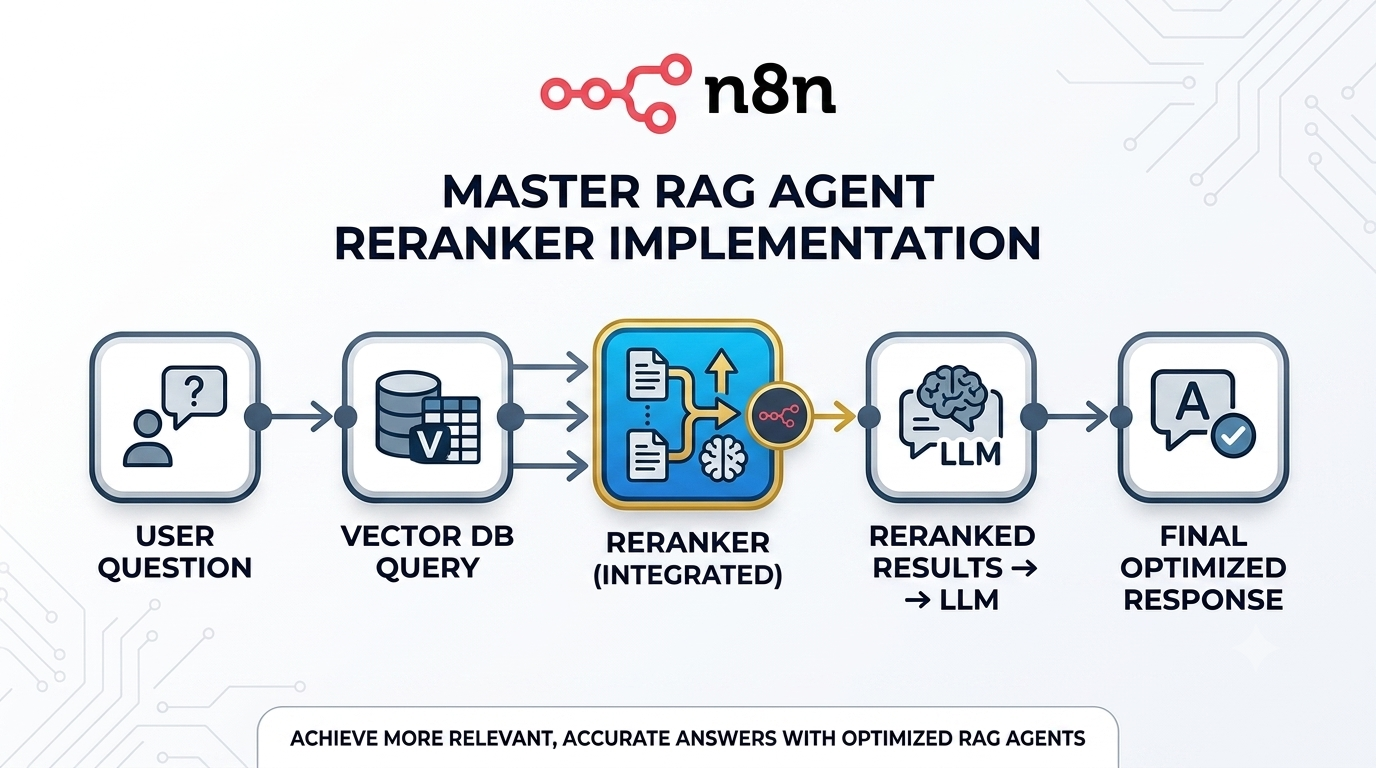
When engineering intelligent retrieval-augmented generation systems, deploying a RAG agent reranker stands out as one of the most impactful yet straightforward enhancements you can implement. This comprehensive walkthrough explores the mechanics behind reranking technology, provides a practical implementation guide using n8n’s visual workflow builder alongside Cohere’s ranking API, and reveals how strategic metadata utilization enables surgical-precision context retrieval. After completing this guide, your AI assistants will consistently fetch information that’s genuinely aligned with user intent—not just statistically proximate.

Understanding the Core Value of a RAG Agent Reranker
Traditional vector-based retrieval operates on semantic similarity—locating text fragments that occupy nearby positions in embedding space relative to your query. However, mathematical closeness doesn’t automatically translate to contextual usefulness. A retrieved chunk might discuss general golf terminology when the user specifically needs guidance on penalty procedures for out-of-bounds shots.
This limitation is precisely where a RAG agent reranker delivers transformative value. Rather than restricting initial retrieval to just 3-4 nearest neighbors, your system fetches a broader candidate pool (typically 20-30 chunks), then processes these through a specialized ranking model. The reranker evaluates each candidate against the original query, computes relevance probabilities, and surfaces only the highest-confidence matches. The result? Your language model receives context that directly addresses user needs—not merely content that shares vocabulary or thematic elements.
Primary advantages of integrating reranking capabilities:
- Enhanced response fidelity: Eliminates semantically adjacent but contextually mismatched results
- Lower hallucination probability: Agents operate with verified, high-quality source material
- Adaptive retrieval depth: Expand initial candidate sets without exceeding LLM context constraints
Practical Implementation: Configuring Your RAG Agent Reranker
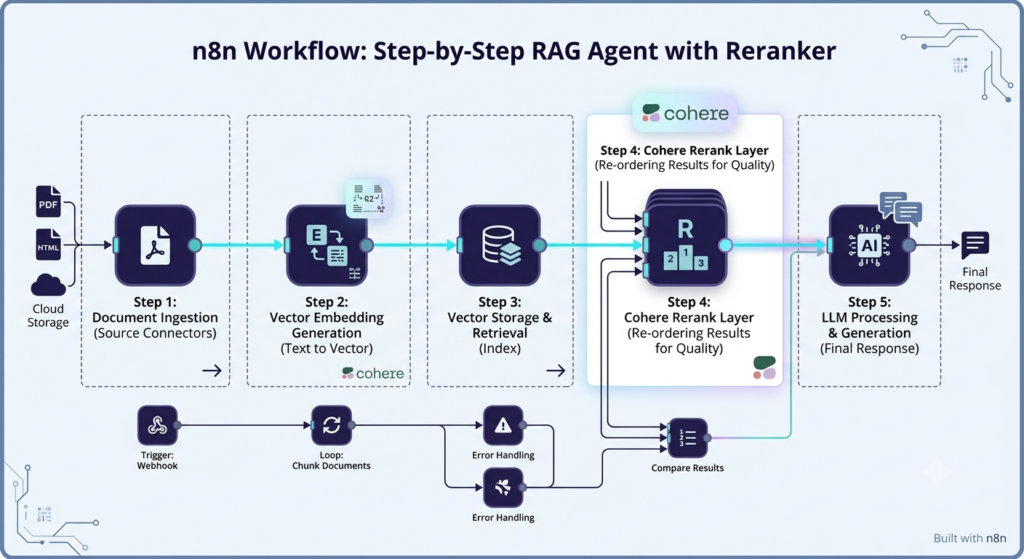
Deploying reranking functionality within n8n requires minimal technical overhead. Below is a streamlined approach using Cohere’s enterprise-grade ranking infrastructure.
Foundation Setup and Node Configuration
Before proceeding, verify these prerequisites:
- An active n8n workflow with Supabase vector store connectivity
- Documents pre-processed into chunks with embedded metadata fields
Within your Supabase Vector Store node configuration:
- Adjust the
limitparameter upward from its default value of 4 to approximately 20-30. This expands the initial retrieval dataset available for reranker evaluation. - Enable the “Rerank Results” toggle to activate the ranking service connection.
- Select Cohere as your ranking provider and supply your API credential (obtain one freely via Cohere’s developer portal).
Model Selection and Performance Tuning
Cohere currently maintains several ranking model variants. For most production scenarios, rerank-english-v3.5 delivers optimal equilibrium between inference speed and accuracy performance. While experimentation with alternative versions is possible through Cohere’s technical documentation, beginning with v3.5 is advisable for stable deployments.
Professional recommendation: Monitor relevance confidence scores within execution logs. Values exceeding 0.70 typically indicate high-certainty matches. Consider implementing conditional branching downstream to filter out results below predetermined thresholds, establishing an additional quality assurance layer.
Strategic Metadata Integration for Targeted Retrieval
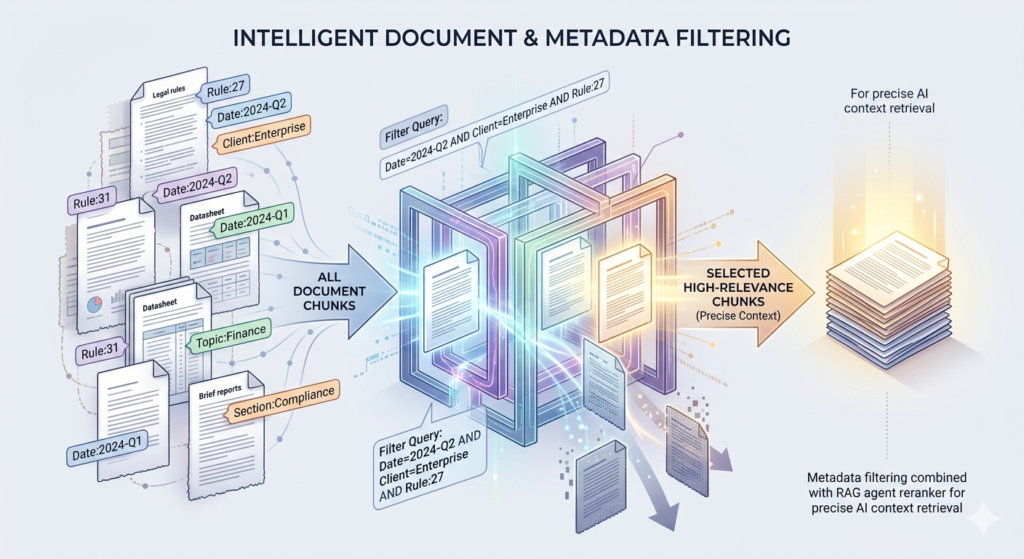
Although reranking substantially elevates relevance precision, combining this capability with metadata filtering unlocks enterprise-grade retrieval accuracy. Consider this practical example: your vector repository contains golf regulation documents, but Rule 3 spans three distinct text chunks. Without contextual metadata, a query for “Rule 3” might retrieve unrelated segments that coincidentally reference “rule” or numerical identifiers.
Embedding Metadata During Document Ingestion
When processing documents through n8n’s Default Data Loader component:
- Implement a Code node to extract structured contextual attributes (e.g., regulation numbers, timestamps, project identifiers)
- Map these attributes to the
metadataparameter within your vector storage operation - Ensure every text chunk carries descriptive tags such as
regulation_id: 27orsession_date: 2024-06-20
This methodology transforms your retrieval approach from probabilistic guessing to deterministic filtering. Instead of relying on semantic search to locate “Rule 27,” you can explicitly constrain results: regulation_id = 27.
Architecting Metadata-Aware Agent Workflows
For dynamic filtering capabilities, design a dual-agent architecture:
- Context Interpreter Agent: Analyzes incoming queries and determines applicable metadata constraints (e.g., identifies “Rule 27” → establishes
regulation_id: 27) - Retrieval Execution Agent: Applies metadata filters alongside reranking to fetch precisely relevant content segments
n8n workflow automation guides – aitoolsupdates.net
Within your Supabase Vector Store node configuration, append a metadata filter object:
json123
This constraint guarantees only chunks tagged with Rule 27 enter the reranking evaluation pool—substantially improving first-attempt retrieval accuracy.
Validation and Continuous Optimization Strategies
Systematic verification remains essential post-deployment. After implementation, examine your agent’s execution telemetry to validate the complete retrieval pipeline:
- Assess initial retrieval breadth: Confirm 20+ candidate chunks are fetched from the vector repository
- Review reranker scoring output: Verify relevance probabilities are computed and only top-ranked results proceed
- Evaluate final response quality: Ensure generated answers directly address queries using high-confidence context
In a practical test scenario querying “Rule 27 golf procedures,” the initial semantic search retrieved content from Rules 26 and 28 due to textual overlap. After implementing a regulation_id metadata constraint, the system retrieved three Rule 27 chunks on the first attempt—with relevance confidence scores of 0.84, 0.76, and 0.71.
Advanced Enhancement Techniques
- Adaptive confidence thresholds: Automatically discard reranked results below 0.70 relevance to prevent low-quality context injection
- Multi-dimensional filtering: Combine
regulation_id,timestamp, anddepartment_codefilters for enterprise-scale precision - Query refinement preprocessing: Implement a preliminary agent to rephrase ambiguous user queries before retrieval execution
AI vector database optimization – aitoolsupdates.net
Final Thoughts: Elevate Your RAG Systems Today
Integrating a RAG agent reranker represents more than a technical enhancement—it’s a strategic differentiator for AI application quality. By combining Cohere’s sophisticated ranking models with n8n’s flexible workflow orchestration and intelligent metadata strategies, you create AI assistants that retrieve contextual information with unprecedented precision. The implementation requires minimal time investment, yet the measurable impact on response accuracy is immediate and substantial.
Begin with focused experimentation: integrate reranking into a single workflow, monitor relevance metrics, then progressively expand to metadata-enhanced filtering. Each iteration strengthens your agent’s reliability, speed, and contextual understanding.
Ready to implement these improvements? Access our complimentary n8n RAG template featuring pre-configured reranker and metadata workflows at aitoolsupdates.net/free-resources. For comprehensive mastery, explore our advanced automation curriculum designed to transform prompt engineers into production-ready AI solution architects.
Cohere reranking API reference – https://docs.cohere.com/docs/rerank
Supabase vector search implementation – https://supabase.com/docs/guides/ai/vector-embeddings
Leave a Reply